-
DestinationRepublic of Mari El, Yoshkar-Ola, Lenin Square
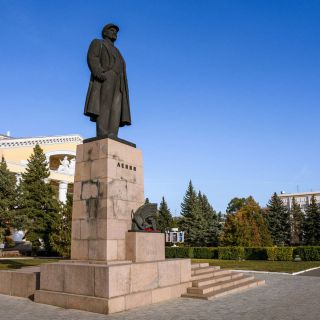
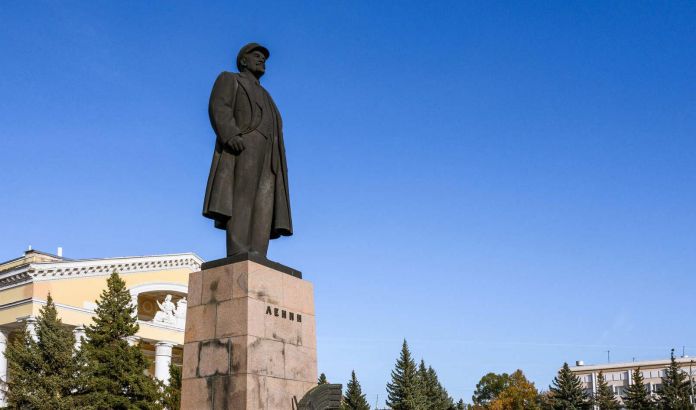
The Lenin monument in Yoshkar-Ola is an important point on the map of the city and its central square. The monument, installed in 1966, became not only an ideological symbol of the era, but also an architectural dominant around which the modern center of the capital of Mari El was formed.
What is interesting about the monument today?
The history of the monument begins during the architectural "thaw", when strict and concise forms replaced the splendor. The decision to install the monument was made by a resolution of the Mari Regional Committee of the CPSU and the Council of Ministers of the Mari ASSR on August 29, 1960.
The author of the sculpture was Matvey Manizer, People's Artist of the USSR, known for his works for the Moscow metro "Revolution Square". The architectural part was designed by Igor Rozhin, one of the leading Soviet architects of his time.
The grand opening took place on November 6, 1966 and was timed to coincide with the anniversary of the October Revolution. After that, the central square was named after Lenin, and Institutskaya Street became Lenin Avenue. The Lenin monument in Yoshkar-Ola actually set a new planning axis of the city.
The monument is a multi-level composition with a total height of 9.65 m. The figure of Vladimir Lenin is 4.5 m. The sculptor depicted him in full height, in a three-piece suit and an open coat. His left hand is hidden in his pocket, and his right hand is slightly clenched into a fist. The slight tilt of the body creates a feeling of moving forward. The sculpture was cast at the Leningrad Monumentsculpture factory. The 4.37 m high pedestal is made of red granite. On the front side there is a bronze stele with reliefs: a sickle, a hammer, a sheaf of ears, an anvil and a gear – symbols of labor and the industrial era.
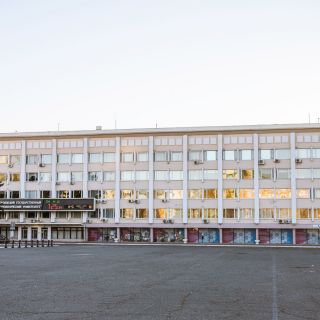
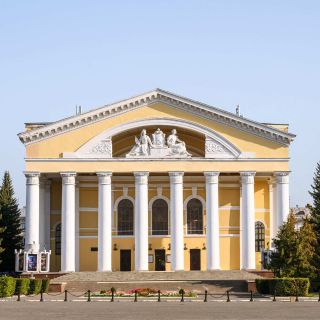
The monument is set at the intersection of visual axes. It is clearly visible from Leninsky Prospekt and Gagarin Avenue. The Mari National Drama Theater named after M. Shketanand the Government building of the Republic of Mari El are organically integrated into the ensemble of the square.
Interestingfacts
- In 1974, the monument was taken under the state protection of the RSFSR.
- To select the exact installation location, a full-size plywood mock-up was moved around the area. The
- total weight of the structure is estimated in tens of tons. The
- sculpture was created according to the canons of monumental art approved by the USSR Academy of Arts.
- Lenin Square has long remained the main venue for city demonstrations and celebrations.
Practical information for tourists
Howto
get- By public transportto the stops "Teatralnaya" or "Museum".
- By car: drive along Leninsky Prospekt, then turn onto Volkova Street. There is free parking near the square. On
- foot: The facility is located in the city center and is included in most tourist routes.
Availability: the area of the square is convenient for people with limited mobility.
Tips for tourists
-
The
- best time to visit is during the daytime, when the details of the terrain are clearly visible.
- 5-10 minutes is enough for inspection.
- Photography is allowed. It is
- forbidden to climb the pedestal.
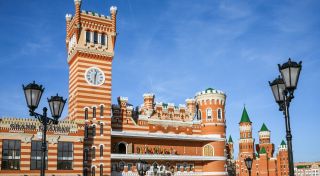
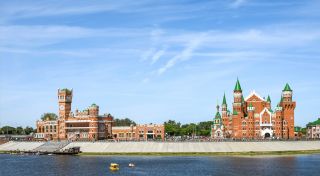
If you are planning a route and thinking about what to see in Yoshkar-Ola, include neighboring objects in the walk: the House of Friendship of Peoples, the National Art Gallery and the Heroes of the Fatherland Museum and Patriotic Center. Connoisseurs of theatrical art will find the repertoires of the Opera and Ballet Theaterand the National Drama Theater within walking distance interesting.
Where to stay and eat
The Revizor, People Town and Vernissage hotels are located near Lenin Square. You can have lunch at the cafe "Simple food", "Little Chicago" or the restaurant "Guests".
The Lenin monument in Yoshkar-Ola remains an important part of the urban space. It is not only a witness to the epoch, but also an important element of the architectural ensemble of the center. When planning a walk around the capital of Mari El, be sure to stop at Lenin Square to see how history shapes the face of a modern city.
Our Location
Photo Gallery