-
DestinationRepublic of Mari El, Yoshkar-Ola
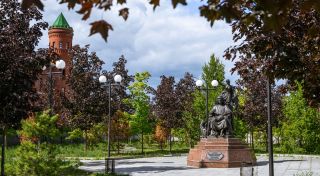
The monument to Chavain in Yoshkar-Ola is a symbol of Mari literature and national memory. The monument was erected in honor of Sergey Chavain is a poet, playwright and educator, whose fate became a reflection of the dramatic pages of the 20th century. The sculpture on the main boulevard of the city seems to invite you to stop and think: where does the culture of the people begin?
The history of the monument to Chavain is closely connected with the biography of the poet himself. Sergey Chavain was born in 1888 in the village of Malye Karamasy. In 1905, he published the poem "Oto" ("Grove"), which became an important milestone for Mari poetry. The work has been translated into dozens of languages.
In the 1930s, Chavain was a recognized author, wrote novels and plays, and worked at the National Theater. However, in 1937 he was arrested and shot. The writer's name was banned. It was only in 1956 that he was rehabilitated, and work began on the return of his legacy.
The idea of erecting a monument to Chavain in Yoshkar-Ola has been discussed for several decades. The project was entrusted to a Moscow sculptor. To Boris Ivanovich Dyuzhev. He studied archival materials and communicated with the writer's relatives in order to achieve an exact resemblance.
The grand opening took place on July 21, 1978, to mark the poet's 90th birthday. The monument was placed at the intersection of Chavaina Boulevard and Sovetskaya Street.
The monument is made in a classical manner. Chavain is depicted in full height, crouched on a ledge. In his left hand he holds a book, a symbol of the educational mission. The sculpture is cast in bronze. The dark metal emphasizes the restrained character of the image. The pedestal is made of massive blocks of gray granite. The composition is harmoniously integrated into the space of the boulevard. The author managed to create an image of an intellectual close to the people. There is no ostentatious solemnity in the pose. It seems that the writer has only been distracted from reading for a minute and is watching passersby.
Interestingfacts
- A similar monument, made according to the same model, has been erected in the village of Morki.
- Initially, the dates "1888-1942" were indicated on the pedestal. Later, historians established that the poet was shot in 1937, and the inscription was changed. Chavain
- Boulevard is considered one of the main walking areas of the city. The
- work "Otho" has been translated into more than 40 languages.
Practical information for tourists
How to get to the Chavain Monument
- By public transportto the CPKiO bus stop.
- By car: From the Central Park of Culture and Recreation,drive along Komsomolskaya Street to Chavaina Boulevard. Parking is possible on Sovetskaya Street. On
- foot: From the Central Park of Culture and Recreation — about 5-7 minutes along the boulevard.
Availability: the territory is open and convenient for visitors with limited mobility.
Tips for tourists
-
The
- best time to visit is during the daytime.
- 5-10 minutes is enough for inspection.
- Take a camera: the bronze figure is especially expressive in soft light. Do
- not climb the pedestal and keep it clean.
Nearby are: Central Park of Culture and Recreation, Academic Drama Theater named after G. Konstantinov, Blagoveshchenskaya Tower. This is a convenient route point for those who are planning what to see in Yoshkar-Ola in one day.
Where to stay and eat
The following hotels are located within walking distance: Revizor and Onar. Along the boulevard there are many cafes with a wide variety of cuisine.
The monument to Chavain in Yoshkar-Ola is a reminder of the power of words and historical memory. The monument helps to better understand the culture of the Mari people. A walk along Chavain Boulevard will be an important part of exploring the city and its past.
Our Location
Photo Gallery